

Golf Marker Wristband vs Pocket Marker: Which Wins?
Table of Contents
- Golf Marker Wristband vs Pocket Marker: The Core Trade-Off
- A Magnetic Golf Marker Wristband Solves the Access Problem
- When a Pocket Golf Ball Marker Still Makes Sense
- Choosing a Golf Ball Marker Holder: Weight, Size, and Durability
- Security and Loss Prevention: Which One Keeps Its Marker?
- Comfort, Fit, and Movement on the Course
- Price and Value: What You Actually Pay
- Conclusion
- Frequently Asked Questions
Last Updated: October 19, 2026
Golf Marker Wristband vs Pocket Marker: The Core Trade-Off
The golf marker wristband vs pocket marker debate comes down to one question: do you want your ball marker in your hand before you reach the green, or do you want to dig for it after you arrive?
Here is the short answer. A golf marker wristband wins on access and consistency. A pocket marker wins on price and tradition. Which one fits you depends on how often you play and how much you hate searching.
A golf ball marker holder is any device that keeps a marker attached to your person or gear, whether that is a wristband, a hat clip, or a belt-mounted clip. The holder matters more than the marker itself, because the marker is the cheap part. Losing track of it is the expensive part.
Below, we compare both formats across weight, durability, security, comfort, and price so you can pick the right one for your round.
A Magnetic Golf Marker Wristband Solves the Access Problem
Picture this: you walk onto the putting green, and your marker is already on your wrist. No pocket pat-down. No hat fumble. No walking back to the cart.
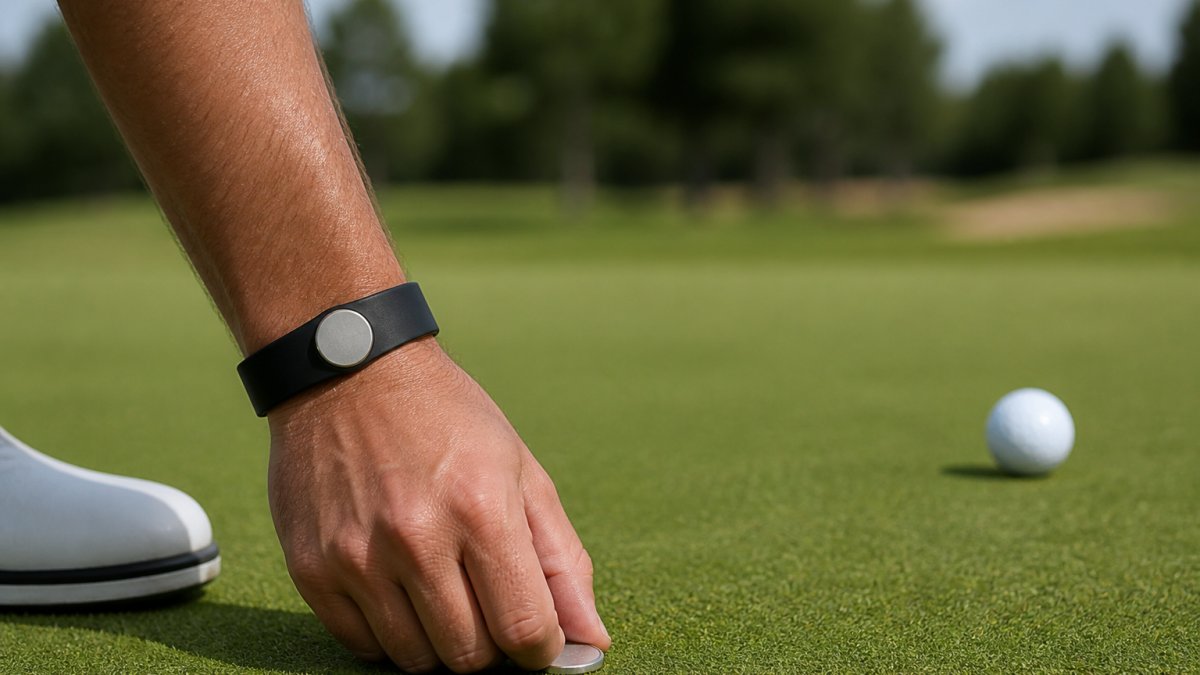
That is the entire argument for a magnetic golf marker wristband, and it is a strong one. The magnetic slot holds the marker flat against your wrist, so you reach over, lift it off, mark your ball, and place it back without breaking stride.
Access speed is the real benefit, not novelty. A pocket marker requires three steps every hole: find it, pull it out, put it back. A wristband cuts that to one motion.
When a Pocket Golf Ball Marker Still Makes Sense
A pocket golf ball marker is not obsolete, but the case for it is narrower than most articles admit. The honest comparison is not "old versus new", it is how each carrying style behaves on the holes where marking actually happens.
Start with access. A pocket marker requires a sequence: locate it, pull it out, mark the ball, pick it back up, return it. On a crowded green with a group behind you, that sequence is where pace of play quietly leaks.
Security is the second split.
So when does the pocket still win?
- Committed traditionalists. If you have carried the same coin or poker chip for years and have never lost one, changing a locked-in routine for a marginal gain is a bad trade.
- Golfers who dislike anything on the wrist. Some players feel any band, watch, or bracelet at address. That is a legitimate preference, and no access advantage outweighs a swing thought you cannot shake.
- Players who carry multiple markers loose. A pocket full of spares is convenient until it is not, but if you like swapping markers by feel, a pocket delivers that without a holder.
- Casual or occasional rounds. If you play a handful of times a season, the loss risk is low and the upfront cost of a holder is harder to justify.
There is also a rules and etiquette angle worth knowing.
A useful middle ground exists: a hat clip or belt clip holds a marker where you can reach it without wearing anything on your wrist.
Choosing a Golf Ball Marker Holder: Weight, Size, and Durability
Weight and size decide whether a holder disappears on your wrist or annoys you for eighteen holes. Durability decides whether it survives a season.
Here is how the two formats compare on the specs that matter:
| Factor | Wristband Marker | Pocket Marker |
|---|---|---|
| Weight | Light, distributed across wrist | Negligible until you carry several |
| Size | Fixed band, marker stays small | Marker size varies widely |
| Material | Silicone band, metal or plastic marker | Plastic, metal, or poker chip |
| Durability | Band wears slowly, magnets hold | Marker chips and scratches |
| Visibility | Always visible on wrist | Easy to misplace |
| Best for | Frequent players, pace of play | Traditionalists, minimalists |
On materials, plastic marker options are light and economical but scuff and fade faster. Metal marker options feel more premium and hold their finish longer, though they cost more and can be heavier. A poker chip marker is the bulkiest of the pocket options, which makes it easy to spot but awkward in a slim pocket.
The band itself matters as much as the marker. Silicone resists sweat and water, which is why Golf Bandz uses a waterproof and sweatproof silicone band rather than leather or fabric. Leather stretches and holds moisture. Fabric frays.
Security and Loss Prevention: Which One Keeps Its Marker?
Security is where the wristband argument gets strongest, and where the pocket argument quietly falls apart.
A magnetic marker on a wristband stays attached to your body through the whole round. It does not fall out when you pull a glove from your pocket or reach into the rough for a stray ball. The failure mode is a weak magnet, not a lost pocket.
Pocket markers fail in three predictable ways. They slip out of a pocket when you sit or crouch. They get set down on the green and forgotten. They fall into the bottom of a bag and are never seen again.
Golf Bandz addresses this with three ultra-strong magnetic slots, so you can carry spares without carrying loose metal in your pocket. The band stays on your wrist, and the markers stay on the band.
Comfort, Fit, and Movement on the Course
Comfort decides whether you actually wear the thing, and fit decides comfort. A band that pinches gets taken off by the fourth hole and never put back on.
An adjustable silicone band solves most fit problems because it tightens to your wrist rather than relying on a fixed size.
Movement is the other concern. A well-fitted band does not shift during a swing movement, and the marker sits flat enough that it does not catch on a glove or sleeve. A loose band slides, which is distracting at address.
Skin irritation is rare with silicone but worth mentioning. If you sweat heavily or play in heat, take the band off after the round and rinse it.
Left-handed golfers get the same experience as right-handed ones. The band is symmetric, so it works on either wrist with no adjustment beyond which hand feels natural.
Price and Value: What You Actually Pay
Price is where pocket markers look unbeatable and where the comparison gets more interesting than it first appears. The sticker price is only half the story, the other half is how often you replace what you lose.
A basic loose marker costs very little, and that is a real advantage. If you lose it, you replace it without thinking. The catch is frequency.
A wristband costs more upfront but bundles the holder and the markers together. Golf Bandz sells The Classic Black Wristband and The Crisp White Wristband at $18.99 each, and both include the adjustable silicone band with strong embedded magnets.

Here is the practical value math, using round numbers rather than invented statistics:
- Occasional player (a few rounds a season): loss risk is low, so a cheap pocket marker is genuinely the better value. The wristband's access advantage rarely shows up in a casual round.
- Regular player (weekly or more): if you have already replaced the same marker two or three times, you have likely spent more than the band costs. At that point the wristband is the cheaper option over a season, not the more expensive one.
- Walker who plays ready golf: the access advantage is worth more than the price difference because it saves time on every green, not just the ones where you lose a marker.
Value also depends on what you are actually buying. A plastic marker is light and economical but scuffs and fades faster, so it looks worn sooner.
One more cost most buyers forget: the replacement errand. A lost pocket marker means a trip to the pro shop or an online order, and the replacement is rarely the same marker you liked.
Conclusion
The challenge with any golf accessory is that it has to earn its place in your routine, and most do not. A marker holder is different, because the friction it removes shows up on every single hole.
If access and consistency matter to you, a magnetic wristband from Golf Bandz is the practical pick. The adjustable silicone band fits either wrist, the three embedded magnetic slots hold spare markers securely, and the waterproof design survives sweat and rain. With 27 interchangeable marker designs, you can swap styles to match your foursome or your mood.
If you are a committed traditionalist who has never lost a marker, keep your pocket routine. Either way, pick a holder and stop digging.
Frequently Asked Questions
Is a magnetic golf marker wristband more convenient than carrying a marker in your pocket?
For most golfers, yes. A magnetic golf marker wristband keeps a ball marker on your wrist, so you never dig through pockets, hats, or bags on the putting green. That saves a few seconds per hole and reduces the chance of losing a marker in thick grass. A pocket golf ball marker is cheaper and familiar, but it can slip out unnoticed. If you play often and value pace of play, the wristband is the more convenient option.
Can a golf marker wristband hold more than one ball marker?
Some models can. The Golf Bandz wristband has three magnetic slots, so you can carry multiple markers and swap designs between holes. That matters if you like customizing your look or want a backup in case one marker comes loose. Most pocket markers hold only one marker, so a wristband with multiple slots offers more flexibility without extra pocket clutter.
Do golf marker wristbands stay comfortable during a round?
Comfort depends on the band material and fit. Adjustable silicone bands like Golf Bandz are waterproof and sweatproof, and they sit flat against the wrist without pinching. A proper fit matters more than the brand: the band should be snug enough not to slide but loose enough to avoid skin irritation. If you have sensitive skin or play in heat, an adjustable silicone band is usually more comfortable than a metal or elastic band.
How do you keep a pocket golf marker from getting lost?
A pocket marker is easy to lose because it sits loose in fabric. To reduce risk, attach it to a clip or a small holder, keep it in the same pocket every round, and avoid carrying it in a pocket with tees or a divot tool. A golf ball marker holder with a magnetic or clip attachment keeps the marker secured. If you lose markers often, a magnetic golf marker wristband removes the pocket entirely and keeps the marker on your wrist.
Ready to stop searching your pockets on the green? Get started with Golf Bandz and keep your marker where you can actually reach it.
USGA Rules of Golf on marking and lifting the ball
American Golf Course Superintendents Association guidance on pace of play
Consumer Product Safety Commission guidance on silicone consumer products